Bottom Roller Eccentricity: Measuring Runout on the Drafting Line
Vindex technical notes · 12 Nov 2026
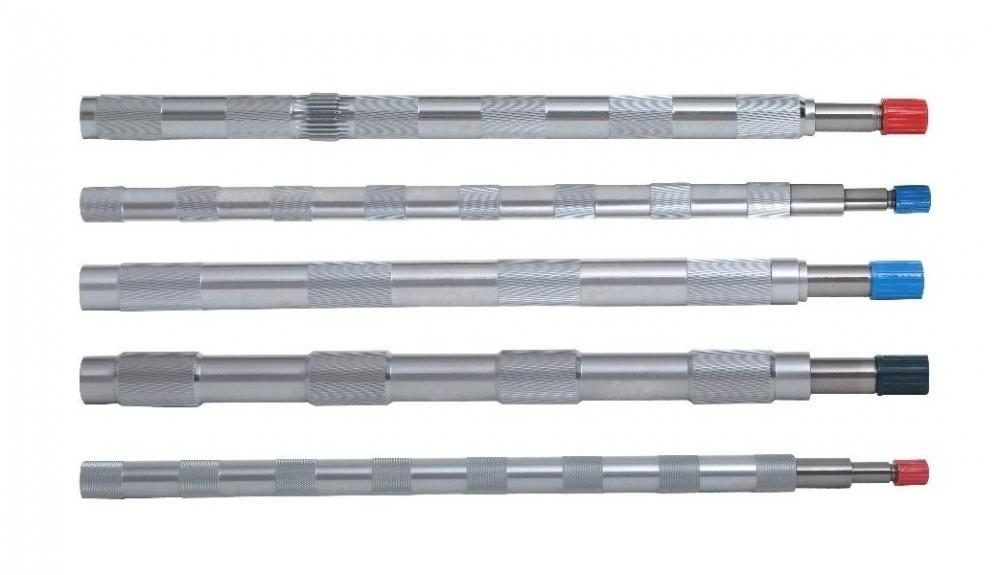
What eccentricity means on a bottom roller
A bottom roller should turn on its true centre. Eccentricity means it does not: the roller's surface moves in and out as it turns, so the gap between the bottom roller and the top roller opens and closes once per revolution. That movement is called runout, and on the drafting line it shows up directly in the yarn — the draft varies with every turn, and thick and thin places follow the roller round.
The drafting line depends on a steady nip. The top roller presses the fibre strand against the bottom roller, and the two together carry the strand forward at a set draft. When the bottom roller runs out, the nip pressure varies, the strand is gripped unevenly, and the yarn coming off the frame carries the fault. A single eccentric roller can mark the yarn from every spindle it feeds.
Measuring runout with a dial gauge
The usual workshop check is a dial gauge held against the roller surface while the roller is turned slowly by hand. The gauge needle shows how far the surface moves in and out over one full turn. The roller is checked at more than one place along its length, because a roller can run true at one end and out at the other, and it is checked in its working position where possible, so that the bearings and seating are part of the reading.
A roller that reads steady at every point along its length is running true. A roller whose needle swings at the same place on every turn has a fixed eccentricity — a bend, a worn journal, a bearing seat fault or a roller that was never true from the start. The reading, the place where it happens and whether it repeats on every turn are all noted before any decision is made.
The listed values for the DJ bottom roller
Vindex bottom rollers are CNC-machined for ring-frame, drawing-frame, comber, simplex and compact spinning positions. The product data lists the DJ model in No.45 special carbon steel, in roller diameters of φ25 or φ27, with dynamic pulsation of ±0.02 mm and a maximum of ±0.03 mm.
Those listed values are the reference for the DJ roller. Any reading taken in the mill is checked against the drawing and the maker's limit for the roller and the machine it runs on, not against a figure remembered from another roller. A reading outside the limit means the roller comes out for attention; a reading within the limit, with yarn faults still showing, points the search elsewhere on the drafting line.
What causes eccentricity
Eccentricity builds up from ordinary mill causes. Bearings wear and let the roller sit off centre; a roller dropped or struck in handling can carry a bend; a journal worn oval will not seat true however well the roller body measures. Rollers refitted without cleaning the seat, or run with a damaged top roller pressing unevenly, can also show runout that belongs to the seating rather than the roller itself.
The check is therefore done in two steps: the roller alone, then the roller in its working seat. If the roller reads true on its own but runs out in the frame, the seat, the bearings or the top roller are the suspects. If it reads out on its own, the roller itself is the fault, and it is dealt with as a roller.
What to send with your enquiry
Send these details with your enquiry:
- Machine manufacturer, model and drafting position.
- Current bottom roller model, diameter and length.
- The dial-gauge reading and where along the roller it was taken.
- Whether the fault repeats on every turn and which spindles it affects.
Vindex manufactures bottom rollers at Surendranagar, Gujarat, and exports textile machinery spares to spinning mills in 87 countries. Send your machine details and roller sizes, and the match will be confirmed against the drawing before a quotation is given.
Frequently asked questions
What is bottom roller eccentricity? It is runout — the roller surface moving in and out as the roller turns, so the drafting nip opens and closes once per revolution and the yarn comes out uneven.
How is runout measured? With a dial gauge held against the roller surface while the roller is turned slowly by hand, checked at more than one place along its length, and compared with the drawing and the maker's limit.
Where Vindex supplies: 87 countries, all Indian states
Vindex Industries exports textile spindles and bolsters to 87 countries. Among the leading buyer markets are Bangladesh, Turkey, Indonesia, Vietnam, Uzbekistan, Pakistan and Egypt, alongside mills across Asia, Africa, the Middle East, Europe and the Americas. Country-level export pages: Export-country directory
---
Seeing uneven yarn from a drafting position? Send your machine make and model and the bottom roller sizes to Vindex Industries — WhatsApp +91 89805 05555, vindex@vindexindustries.com, or enquire at vindexindustries.com.
Frequently asked questions
Which bottom-roller conditions should maintenance cover?
Inspect flute condition, surface wear, eccentricity and contamination. The guide connects these checks with drafting consistency and periodic faults.
Why should fly and oil be removed from the drafting zone?
Contamination can interfere with consistent fibre control and roller contact. Include cleaning and inspection in the machine maintenance routine.
Choose the Correct Replacement Roller
After inspection, identify the machine process and the original roller drawing before ordering. Use the ring-frame bottom roller page for ring-spinning positions, the roving / speed frame bottom roller page for simplex machines, or the fluted roller reference page to describe the working profile. Keep each roller position and quantity separate in the enquiry.