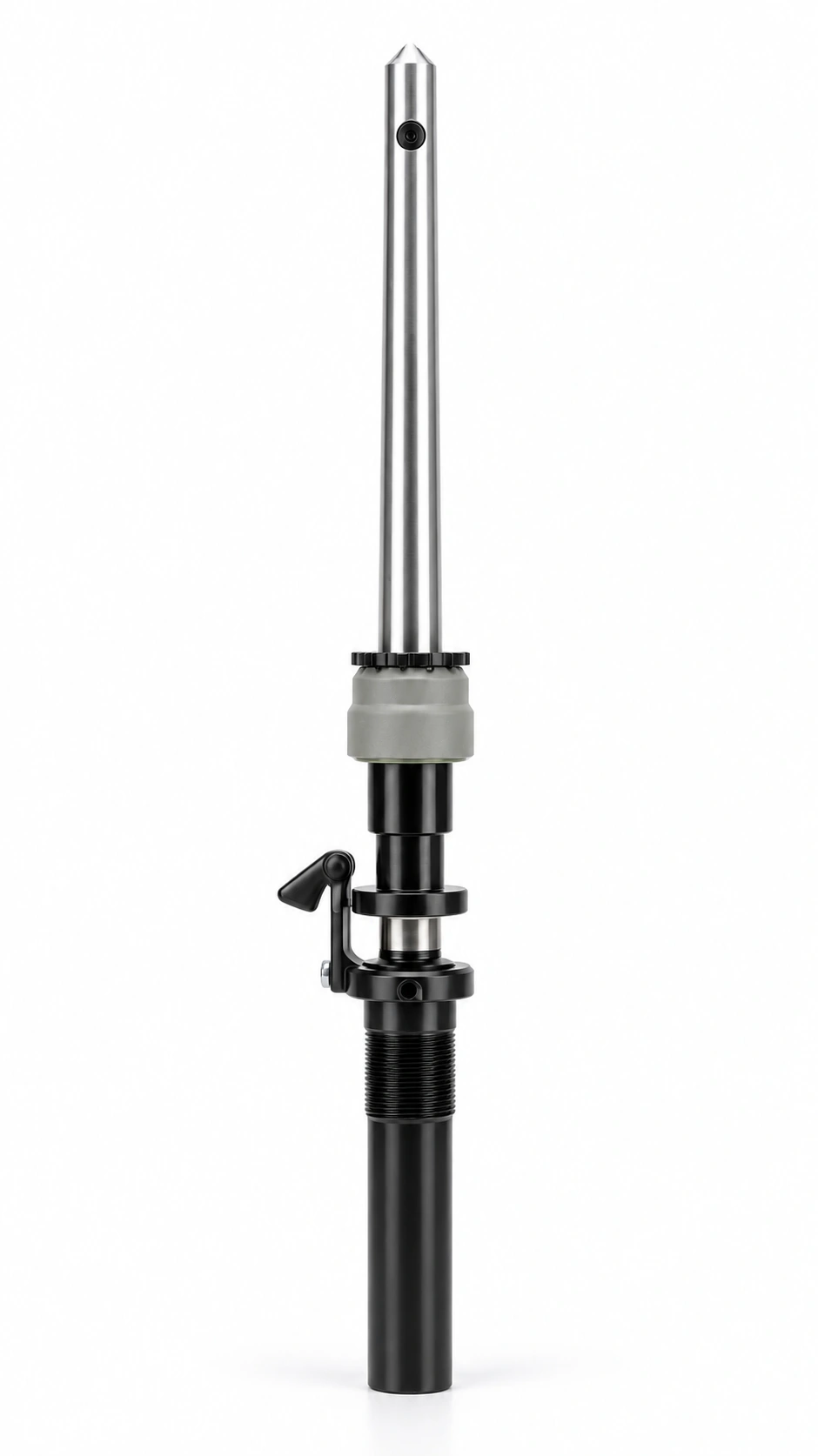
What the blade does
The blade is the long, slender steel part of a textile spindle. It carries the tube and the yarn package, runs inside the bolster, and turns at the full speed of the frame — Vindex ring-frame spindle bolsters run at speeds up to 30,000 RPM. Everything about the blade — its steel, its hardness and its straightness — shows up directly in how the spindle runs.
A blade that is true and sound runs quietly, holds the package steady and lets the bolster bearings do their work. A blade that is bent, nicked or wrongly hardened brings vibration, uneven yarn and early bearing wear. The blade is a small part, but it decides much of the spindle's behaviour in service.
EN-31 steel: the blade material
Across the Vindex product data, the blade material is EN-31 steel. It is listed for ring-frame bolsters, TFO bolsters, doubling and twisting spindles, and winder spindles alike — from the HF range (HF-1, HF-21, HF 33, HF 44, HF 45, HF-100) to the HZ range (HZ-33, HZ-44, HZ-55, HZ-66, HZ-68, HZ-77, HZ 35, HZ-2C). The wharve paired with it is EN-24 steel, and the aluminium plug, where fitted, is LM-6.
EN-31 is a high-carbon steel chosen for the blade because the blade must be hard enough to resist wear where it runs in the bolster, yet tough enough to take the bending and vibration of mill service without cracking. That balance is the whole point of the material choice: hardness alone is not enough, and toughness alone is not enough.
What breaks blades
The most common cause of blade breakage in general mill service is a hardness balance gone wrong. A blade hardened too far becomes brittle: it may look and measure well, but a knock during handling, a jam at doffing or a sudden shock in running can snap it. Over-hardness is a general cause of blade breakage, and it is one reason blades are checked for hardness as well as for size.
Other causes are ordinary workshop and mill faults. A blade dropped or struck during handling can carry a nick or a bend that becomes a break under running load. A spindle fitted into a bolster with a damaged seat, or run with a worn bearing, can vibrate until the blade fails at the stressed point. A tube that does not sit true on the blade adds the same kind of uneven load. None of these is a material fault on its own, but each of them breaks blades in service.
Checking a blade before fitting
Before a blade or a spindle is fitted, the checks are simple and worth doing every time:
- Look along the blade for bends, nicks or score marks, and check the tip and the wharve seat.
- Check that the blade fits the bolster freely and sits true, without forcing.
- Confirm the spindle model, lift and wharve diameter against the drawing for the machine.
- Check that the tube seats evenly on the blade, with no wobble.
A blade that fails any of these checks should not be fitted. In mill service, the time spent checking is far less than the time lost to a broken blade and a stopped spindle position.
Vindex manufactures textile spindles and bolsters at Surendranagar, Gujarat, and exports textile machinery spares to spinning mills in 87 countries. Send your machine details and spindle model, and the match will be confirmed against the drawing before a quotation is given.
Frequently asked questions
What steel are Vindex spindle blades made from? EN-31 steel, listed across the HF and HZ spindle and bolster ranges, with EN-24 steel wharves and HE30-T6 / AA 6082-T6 aluminium plugs where fitted.
What breaks spindle blades? Over-hardness is a general cause — a blade hardened too far turns brittle and can snap under shock. Handling damage, bent blades, worn bolster bearings and tubes that do not sit true are other common causes.
Where Vindex supplies: 87 countries, all Indian states
Vindex Industries exports textile spindles and bolsters to 87 countries. Among the leading buyer markets are Bangladesh, Turkey, Indonesia, Vietnam, Uzbekistan, Pakistan and Egypt, alongside mills across Asia, Africa, the Middle East, Europe and the Americas. Country-level export pages: Export-country directory
---
Replacing spindle blades or matching a spindle to your frame? Send your machine make and model and the current spindle sizes to Vindex Industries — WhatsApp +91 89805 05555, vindex@vindexindustries.com, or enquire at vindexindustries.com.
Frequently asked questions
Which bottom-roller conditions should maintenance cover?
Inspect flute condition, surface wear, eccentricity and contamination. The guide connects these checks with drafting consistency and periodic faults.
Why should fly and oil be removed from the drafting zone?
Contamination can interfere with consistent fibre control and roller contact. Include cleaning and inspection in the machine maintenance routine.
Choose the Correct Replacement Roller
After inspection, identify the machine process and the original roller drawing before ordering. Use the ring-frame bottom roller page for ring-spinning positions, the roving / speed frame bottom roller page for simplex machines, or the fluted roller reference page to describe the working profile. Keep each roller position and quantity separate in the enquiry.